I found
this explanation on
MTBR.com to be very informative!
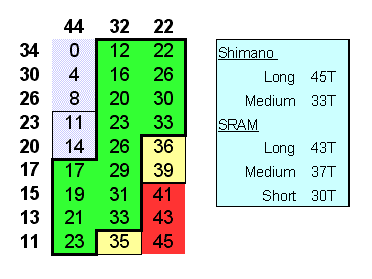
"Derailleurs have a rated capacity. This is their ability to take up excess chain. After all, you need just about all of your chain to run in the big-big combo, whereas you have a bunch of extra links doing nothing when you run in your small-small combo. Not that either of those cross-chain combos are normal to run in, but let me get to that in a minute. Manufacturer stated derailleur capacities are as follows: Shimano long = 45T; medium = 33T SRAM long = 43T; medium = 37T; short = 30T Speaking from experience, Shimano is a bit conservative in their capacity rating. I can only assume the same is true of SRAM (I'll get to that, too). The easy capacity formula is to add your big ring & cog sizes, then subtract your small ring and cog sizes. It looks like this: cap req'd (T) = (BIG ring - small ring) + (BIG cog - small cog)
...so for a typical 44-32-22 mountain crank & 11-34 cassette... T = (44T - 22T) + (34T - 11T)
.. = (22T) + (23T)
.. = 45T
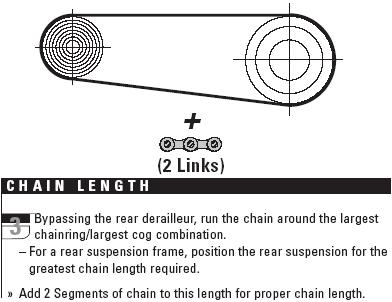
Using this simple forumla, you would need a derailleur with a 45T rated capacity to absorb all the possible extra links of a typical 27-speed drivetrain. (I make the assumption SRAM stated capacity is conservative, since they list 43T as the long cage capacity -- 2T short of what is required by this forumla). Where do shorter cage lengths come into play? Right here! Even though the long cage will, in theory, take you down to the 22x11 gear combo and hold adequate chain tension, let's be logical: 22x11 is a combo you don't use! Rather than use the generic formula, let's map out the capacity for each gear combination (based off of a Shimano cog pattern; SRAM will be slightly different): 44x34 starts off at zero because in that combo, all of the chain is being used up by the ring and cog, and the derailleur needs to take up none of it. As you shift through the cassette range (moving down the column), the amount of free chain increases as the cog size decreases. Take a look at the useable gears, which I've outlined in green and yellow. Those fall near the stated capacity of the medium cage derailleurs. (I mentioned that Shimano's stated capacity is conservative, and in practice, I find their medium cage to be closer to 39T.) For instance, in the middle ring (32) and the small cog (11), the table shows you've got to absorb 35T. This is near the stated capacity of either of the medium cage derailleurs. This gear combo remains useable, but you'd be better off shifting to your big ring for better chain tension. You can also see that to use a SRAM short cage derailleur (30T capacity) on this drivetrain would leave you with two or three unusable gears while in the middle ring, and only about three useable gears from your granny ring. (Any number greater than 30T on the table would be near the limits of the short cage derailleur.) Oops! Accidentally shifted into the unusable "red zone"? Nothing major: the derailleur cage folds back on itself, the chain droops, and you maybe drop the chain if you don't catch it in time. In my opinion, it'd be stupid to size a chain any smaller than what is required to shift into big-big. If you accidentally force a shift into that combo, which is certainly possible when you're tired or "in the moment", you don't want to break anything. So chain length will be the same no matter what derailleur you choose. Benefits of a shorter cage length? - snappier shifts - better chain tension - less chain slap / greatly decreased drivetrain noise (!) - better obstruction clearance / improved spoke clearance. - slight weight loss -- but you gotta be a real weight weenie to appreciate this one. __________________
speedub.nate"