Showing posts with label mountain bike. Show all posts

Wednesday, September 3, 2008

Da Unit: First Impressions

Hooray! New bike! After successfully destroying the drivetrain on my mountain bike and lobbying my wife for the funds, I bought a new bike last weekend from Oasis Bike Works in Fairfax. I've been riding as much as the first week of the school year has allowed and it's been fantastic.

Drinking the 29er Kool Aid
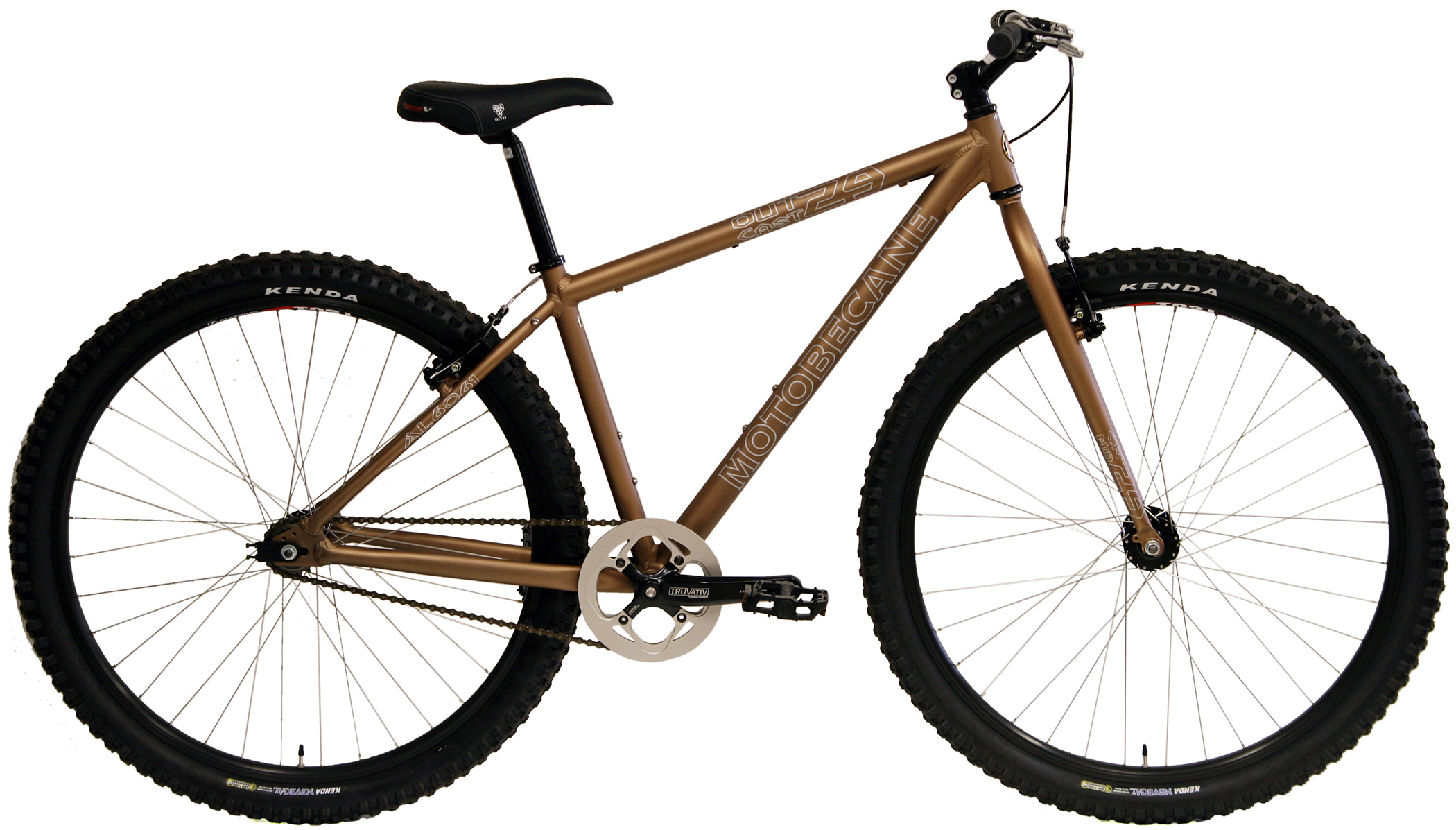
When I bought my Motobecane Outcast 29er last spring, I bought it as a commuter. It has eyelets for a rack and fenders, big wheels to smooth out the road, and a single gear to simplify maintenance. Of course, since it arrived just as school was ending and was set up as mountain bike, I decided that I'd ride it as a mountain bike, at least for the summer.

As a mountain bike, it was adequate. It had some weird quirks (170 mm cranks, 42T chainring, spaced out rear track hub, bolt on front hub) that required "adjustment." I was disappointed to find that the factory had bolted down the rear wheel so tight that it stamped a good sized dent into the aluminum dropouts; ever since then it has been tricky to tighten down the rear wheel without the hub gripping against the dropout and "crawling" forward a bit, throwing off the chain tension. I was never satisfied with it as a mountain bike, which was fine - I had a mountain bike I liked and this bike was meant for the commute.

However, riding the Moto all last summer taught me two things: I like the challenge of riding single speed and I LOVE 29" wheels. Riding with just one gear is fun. Want to go faster? Pedal faster! Need to get up that hill? Hammer down! It forces me to ride more aggressive, to maintain my momentum, and keep up my speed. And it pairs up perfectly with 29" wheels.

In my experience, the 29" wheel platform has two advantages over a tradition 26" wheeled mountain bike: traction and roll-over ability. When you stand on a climb, you get all the traction you need to really hammer. Maintaining momentum is easier with the big wheels since they make trail obstacles relatively smaller. It's amazing to roll through a rock garden at speed on a 29er.

I was really enjoying the Moto as a mountain bike until I rode Fountainhead. For those of you unfamiliar with the rooty, rocky regional park, tucked in among the steep hills of northern Virginia, let me say this: Fountainhead is not for the faint of heart. There are more rocks and roots, impossibly steep climbs, and fast sketchy downhills than you could imagine in an 8-mi. singletrack loop in the middle of a posh suburb.

Because the trail is so rough, it was very difficult to hold speed on the Moto. Rigid and stiff, the aluminum frame communicated every little (or large) bump and dip to my body. Braking like crazy to maintain control on the downhills left me with little speed to carry me up the steep uphills. Fountainhead had schooled me before, but this time I finished battered and beaten.

That was perhaps my last mountain bike excursion on the Moto. Since then, it has acquired a larger gearing, narrower tires, and a rack. (I used it on our Pitt-to-DC bike trip this summer.) Still, the pleasure of singlespeeding offroad on those big hoops kept me dreaming of a new mountain bike.

Doing the Research, Finding the Ride

Flash forward to the beginning of this summer, when my wife started dropping hints that I could buy a new mountain bike. I did my research, visited the local bike shops, and perused craigslist and the MTBR classifieds daily. I wanted a steel 29er that could be set up singlespeed or geared, rigid or suspended. I figured I'd start out rigid and singlespeed, like the Moto. When I lost my first filling, I'd get a suspension fork. When I got tired of walking too many hills, I'd throw some gears on. Versatility was key.

A number of opportunities presented themselves and I decided on a 2008 Kona Unit. (I got lucky too! At the end of the season like this, it was on sale. Plus, it's the last of its kind; Kona has switched to a lower quality steel for the '09. Unit) It's just about exactly what I wanted. I intend on buying a suspension fork eventually. I'd like a nicer wheelset. But, even stock, it's a sweet sweet ride.

New Bike Smell

I bought the bike last Saturday after having test ridden a half dozen times and peppering the guys at Oasis with a salvo of questions. (Dave, Jan, and Tim deserve a huge shout out for their help and patience!) On Labor Day, I took it on its first ride, the classic Tour de Wakefield. Cali and I cruised the trails down by Accotink and played on the singletrack at Wakefield. It was a blast!

The Unit has all of the pluses of the Moto, without the harsh ride. Big wheels? Check! Singlespeed? Check! It's amazing how much smoother it is than the Moto. While it's still a rigid mountain bike - it's hard to forget that when blasting down a rough trail - it's never been as jarring as the Moto. The steel frame and fork have a nice feel to 'em. I am very pleased with it!

Finale: Proof of Excellent Purchase

I LOVE my new bike!

Wednesday, May 16, 2007

Who Knew There Were So Many Pink Parts Out There?

I saw this on BlueCollarMTB and thought I'd share:

"Speedgoat Bicycles is back for another go around of the famed all-pink bicycle raffle. For 2007 the bike is no joke - a BMC Fourstroke02 featuring custom pink parts from Fox, Chris King, Hope, Thomson, Oury, RaceFace, and Velocity. Speedgoat rounds out the build with SRAM X.0 and a host of other parts, along with their excellent mechanical skill of course.

The best part - tickets are $10 each, you can purchase as many as you want, and every last penny going to the Breast Cancer Fund. Thats a pretty good deal all around."

pink3-banner.jpg

Thursday, May 10, 2007

More on Rear Derailers - Shimano Names, Compatibility

Also from a thread on MTBR.com:

"Most rear derailleurs are made the way they have always been, in what Shimano now calls a 'top-normal' configuration. What this means is that if you disconnect the cable, the derailleur returns to the smallest cog, which is the top gear - it's 'normal' state is the top gear, hence 'top-normal.' They wish that we would all buy 'low-normal' derailleurs, which is exactly the opposite - the normal state is the biggest cog, or the lowest gear. So now we have two different models, which in the LX world are M580 (low-normal) and M581 (top-normal).

Then there's cage length, which is confusing enough to the majority of people that it is a sticky at the top of this forum. Basically longer cages allow you to run bigger gear spreads witout fear of cross-chaining in exchange for slower shifting and higher weight. Medium cage derailleurs (the only truly short cages are on road bikes) are far less forgiving of cross-chaining but are lighter and shift quicker. The majority of people in this world use long-cage derailleurs and are thrilled with them. So Shimano makes it's nicer derailleurs in long cage (SGS) and medium cage (GS) flavors for those who want the choice.

So, to end this mini-novel, an LX derailleur comes in 4 flavors:
M580 GS Low-Normal medium cage
M580 SGS Low-Normal long cage
M581 GS Top-Normal medium cage
M581 SGS Top-Normal Long cage. This is the one you should probably get, and in years past this was the only choice you would have ever had."

Also, on SRAM-Shimano compatibility:
  • All Shimano shifters are compatible with SRAM front derailers; all SRAM shifters are compatible with Shimano front derailers.
  • SRAM X.x shifters require SRAM X.x rear derailers.
  • However, SRAM Attack and Rocket shifters are compatible with Shimano rear derailers.

Rear Derailers - Short Cage vs. Long Cage

I found this explanation on MTBR.com to be very informative!

"Derailleurs have a rated capacity. This is their ability to take up excess chain. After all, you need just about all of your chain to run in the big-big combo, whereas you have a bunch of extra links doing nothing when you run in your small-small combo.

Not that either of those cross-chain combos are normal to run in, but let me get to that in a minute.

Manufacturer stated derailleur capacities are as follows:
Shimano long = 45T; medium = 33T
SRAM long = 43T; medium = 37T; short = 30T

Speaking from experience, Shimano is a bit conservative in their capacity rating. I can only assume the same is true of SRAM (I'll get to that, too).

The easy capacity formula is to add your big ring & cog sizes, then subtract your small ring and cog sizes. It looks like this:

cap req'd (T) = (BIG ring - small ring) + (BIG cog - small cog)

...so for a typical 44-32-22 mountain crank & 11-34 cassette...

T = (44T - 22T) + (34T - 11T)
.. = (22T) + (23T)
.. = 45T

Using this simple forumla, you would need a derailleur with a 45T rated capacity to absorb all the possible extra links of a typical 27-speed drivetrain.

(I make the assumption SRAM stated capacity is conservative, since they list 43T as the long cage capacity -- 2T short of what is required by this forumla).

Where do shorter cage lengths come into play? Right here!

Even though the long cage will, in theory, take you down to the 22x11 gear combo and hold adequate chain tension, let's be logical: 22x11 is a combo you don't use!

Rather than use the generic formula, let's map out the capacity for each gear combination (based off of a Shimano cog pattern; SRAM will be slightly different):


44x34 starts off at zero because in that combo, all of the chain is being used up by the ring and cog, and the derailleur needs to take up none of it. As you shift through the cassette range (moving down the column), the amount of free chain increases as the cog size decreases.

Take a look at the useable gears, which I've outlined in green and yellow. Those fall near the stated capacity of the medium cage derailleurs. (I mentioned that Shimano's stated capacity is conservative, and in practice, I find their medium cage to be closer to 39T.)

For instance, in the middle ring (32) and the small cog (11), the table shows you've got to absorb 35T. This is near the stated capacity of either of the medium cage derailleurs. This gear combo remains useable, but you'd be better off shifting to your big ring for better chain tension.

You can also see that to use a SRAM short cage derailleur (30T capacity) on this drivetrain would leave you with two or three unusable gears while in the middle ring, and only about three useable gears from your granny ring. (Any number greater than 30T on the table would be near the limits of the short cage derailleur.)

Oops! Accidentally shifted into the unusable "red zone"? Nothing major: the derailleur cage folds back on itself, the chain droops, and you maybe drop the chain if you don't catch it in time.

In my opinion, it'd be stupid to size a chain any smaller than what is required to shift into big-big. If you accidentally force a shift into that combo, which is certainly possible when you're tired or "in the moment", you don't want to break anything. So chain length will be the same no matter what derailleur you choose.


Benefits of a shorter cage length?
- snappier shifts
- better chain tension
- less chain slap / greatly decreased drivetrain noise (!)
- better obstruction clearance / improved spoke clearance.
- slight weight loss -- but you gotta be a real weight weenie to appreciate this one.
__________________
speedub.nate"

Wednesday, May 9, 2007

Admit It: You're Never Getting Over That Log in One Piece

(Note: this information is probably useful only to me, but this blog happens to be a convenient place to store it away for future reference...)

I run the big chainring on my mountain bike into a lot of stuff - downed logs, rocks, small rodents. Maybe it's time I bought a bashguard. Bashguards are sturdy pieces of plastic or metal designed to protect the chainrings on your mountain bike cranks. Normally, they replace the largest chainring, reducing the weight of the cranks and protecting the teeth of the smaller rings. Since I hardly ever use the largest ring on my mountain bike and routinely hop over a lot of logs, a bashguard might be a good investment. Some things to keep in mind:
  • Bolt pattern: Cranksets use 4- or 5-bolt patterns (i.e. the chainrings are held to the crankset via 4 or 5 bolts). Only a bashguard with the same bolt pattern will fit on your crankset.
  • Bolt Center Diameter (BCD): Distance from bolt to bolt on your crankset. As with the bolt pattern, the BCD of the bashguard must match that of the crankset.
  • Tooth coverage: If you replace the largest ring with a bashguard, usually you buy a bashguard to fit the middle ring. Depending on the size of that ring (usually 32, 34, or 36 teeth), you'll pick your bashguard. Even if you're currently running a 34T middle ring, if you ever plan to put a bigger 36T ring on there, you'd better buy the larger bashguard so you don't have to buy another one later.
Of course, considering all the missing and bent teeth on my large chainring now, I already have a de facto bashguard, eh?

Thursday, April 19, 2007

One Click Too Many

While surfing around online bike retailers, I discovered this deal at Nashbar.com and, boy, has it got the gears turnin'! A generic, steel mtb frame like that is the perfect "clean slate" for an imaginative bike enthusiast. I've already started mapping out plans for a cool commuter bike - mtb frame with carbon fiber mtb fork, disc brakes, road handlebars, fenders, 1 x 8 gearing. It'd be fun to build and fun to commute on. Now, all I need is the money...

Well, if you don't have dreams, you don't have anything! Right? *sigh*

(Seriously, I'm killing myself dreaming about all this bike stuff and not getting any of it. Cali is much wiser than I: "I am happy because my wants are few!")

Friday, April 6, 2007

Bombproof Bike Project

The guys over at Blue Collar Mountain Biking have started the Bombproof Bike Project. The idea is to build a solid, worry-free mountain bike tailored to the new biker. I like this project for two reasons:
  • Mountain bikes require a lot of maintenance and that can be daunting for the new rider. I'd had my road bike for almost two years before I did any sort of maintenance beyond fixing flats and lubing the chain. How long until I had to repair my mountain bike? Two months! It's just the nature of the beast. If you're going to ride on technical (read: fun) trails, your bike's going to take a beating. A tough bike is great for a new rider.
  • Too much of the bike industry is style over substance. Why do we bike? Because it's fun! If you're worried about having the latest and greatest, you're missing the whole point! The Bombproof Bike Project is aimed at delivering a solid bike that will get the new rider riding, rather than worrying over his/her new $2000 investment.
They've got most of the bike already spec'd out. They've made some strange choices in components, like a rigid fork and 7-speed cassette, but by-and-large I think they've got the right idea. My only real criticism is the total cost: way too high to entice new riders when there are bikes on the market with greater bling factor, if less durable. If they chose a cheaper frame, they could cut a huge chunk off the price. (Nothing against the Surly Instigator - I'm sure it's bombproof - but it costs something on the order of $400, only $100 less than what I paid for my entire mountain bike.) Interesting project, though!

(Now if the shop would just finish my front wheel, I'd be riding instead of writing about bombproof bikes!)

Thursday, April 5, 2007

Sweet Street Bike Trials Video

Check out this cool bike video. It's unbelievable what some people can do on their bikes!